API-First Flowline: A Fully Automated Path from AI-Driven Spec Design to Production
An eight-stage contract-first lifecycle—from governance and AI-assisted OpenAPI to CI gates, docs, clients, adoption, and feedback—built with open tooling when there is no single vendor platform.
Part of APIs

One tension shows up again and again in enterprise delivery: squads move fast—sometimes drafting with AI—against an OpenAPI file they treat as theirs, while architecture or platform keeps another copy as the baseline. Nobody argues against governance in a deck; they argue when no one agrees which YAML is truth. Compatibility risk lands late, and consumers notice before the org does.
Many organizations never converge on a single paid contract hub anyway—no SwaggerHub, no WSO2 API Manager, no one vendor “source of truth.” The work still has to happen: contracts must be visible, breaking changes caught early, and delivery fast enough to matter.
This post distills an eight-stage API flowline for reasoning about that problem: from governance and AI-assisted authoring through quality gates, documentation, client generation, consumer adoption, and feedback back into policy. It reflects delivery experience where open, license-light tooling and clear human ownership often matter more than a monolithic platform SKU.
The headline we keep returning to:
AI gives speed. Governance gives trust.
The goal is not prettier docs alone. It is to scale API change safely, shrink integration risk, and make the model repeatable across domains.
Why the flowline exists
We started from a familiar enterprise picture:
- Contracts were not consistently visible to every team that needed them.
- Compatibility risk showed up late—after intent had already hardened elsewhere.
- Squads wanted faster delivery without giving up control.
- We needed something pragmatic that did not depend on expensive platform licensing everywhere.
The question becomes concrete: How do you move faster with AI while still protecting consumers from breaking changes?
A flowline answers that by sequencing who decides what, where contracts live, and what automation is allowed to block—so “faster” does not mean “unreviewed.”
The eight stages (end to end)
We structure the lifecycle into eight stages. They are not eight separate products; they are one story told in order:
| Stage | Focus |
|---|---|
| 0 | Governance — standards, ownership, where truth lives |
| 1 | Spec-driven authoring with AI — draft and structure OpenAPI from requirements |
| 2 | Change proposal with baseline comparison — every change is a diff against a known baseline |
| 3 | Automated quality gates — Spectral-style rules, breaking-change detection, CI enforcement |
| 4 | Documentation publication — consumers read stable, versioned API docs |
| 5 | Client generation — SDKs or stubs from the same contract |
| 6 | Consumer adoption — teams integrate against published surfaces |
| 7 | Feedback loop into governance — pain and exceptions update policy and templates |
The deck uses one slide for the full chain so audiences see how stages connect before zooming in. That full picture is what lets you argue for the model as a lifecycle, not a bag of tools.

Below, each tile matches a stage in order: what it is for, why it sits where it does, then the slide as exported from the presentation.
Stage 0 — Governance
Before anyone drafts paths in OpenAPI, the organization needs rules and ownership: where contracts live, who approves changes, versioning expectations, and how exceptions are recorded. Without this stage, later automation has nothing stable to enforce—you get ad hoc repos and silent drift.
When “standards” become executable, they usually show up as a Spectral ruleset—YAML your pipelines can run so review does not repeat the same structural mistakes. The api-flowline workspace publishes spectral-rules on GitLab; the snippets below are verbatim from rules/ruleset-general.yaml there (Spanish descriptions as shipped—same spirit as the Evidence section: real repo text, not a mock).
extends: "spectral:oas"

rules:

  openapi-version-3-0:
    description: "El contrato debe usar OpenAPI 3.0.x"
    severity: error
    given: $.openapi
    then:
      function: pattern
      functionOptions:
        match: "^3\\.0\\.[0-9]+$"

  https-in-servers:
    description: "Los servers deben usar HTTPS salvo localhost"
    severity: warn
    given: $.servers[*].url
    then:
      function: pattern
      functionOptions:
        match: "^(https://|http://localhost)"
The rest of the catalog—naming, governance, business headers—lives in the same project if you want to fork or diff against your own baseline.

Stage 1 — Spec-driven authoring with AI
Here is where AI is deliberately useful: turning requirements into structured contracts, tightening examples, and speeding up repetitive authoring. This is usually where AI pays off first—faster initial drafts, requirements → structured OpenAPI (paths, schemas, examples), more consistent descriptions across a wide surface, and less toil on repetitive specification work.
The contract remains a proposal. Humans own review and alignment; governance rules and compatibility checks against a baseline still decide what merges. This stage is “fast draft,” not “final truth.”
The next evolution is to apply the same governance instinct—reviewable proposals, agreed baselines, gates that can block—not only to HTTP contracts but to AI agent capabilities themselves: what an agent may do, how behavior is versioned, and how breaking changes are detected before they ship. That thread continues in SkDD: When the Skill Transcends the Spec.

Stage 2 — Merge request and contract baseline
Every meaningful change arrives as a reviewable unit (for example a merge request) compared against a known baseline. Consumers and CI both care about diffs, not greenfield files in isolation. This stage is what makes “what broke?” an answerable question.

Stage 3 — CI gates (Spectral and OASDiff)
If your OpenAPI spec is not blocking merges, it is documentation—not a contract.
Gates turn policy into behavior: style and security rules (for example Spectral), and compatibility checks against the baseline (for example OASDiff). Those checks run on the merge request pipeline: reviewers see pass/fail next to the MR the same way they would for unit tests.
When a gate fails, two things happen together—the merge is blocked until the contract issue is resolved and automation can post feedback into the MR discussion. Nobody has to dig through raw job logs to learn what broke; the tool surfaces an OpenAPI-oriented summary (here, a changelog-style comment from the compatibility step) so the breaking delta is obvious in context.
This is the same shape as in api-flowline: demo branches deliberately trip OASDiff while main stays green.
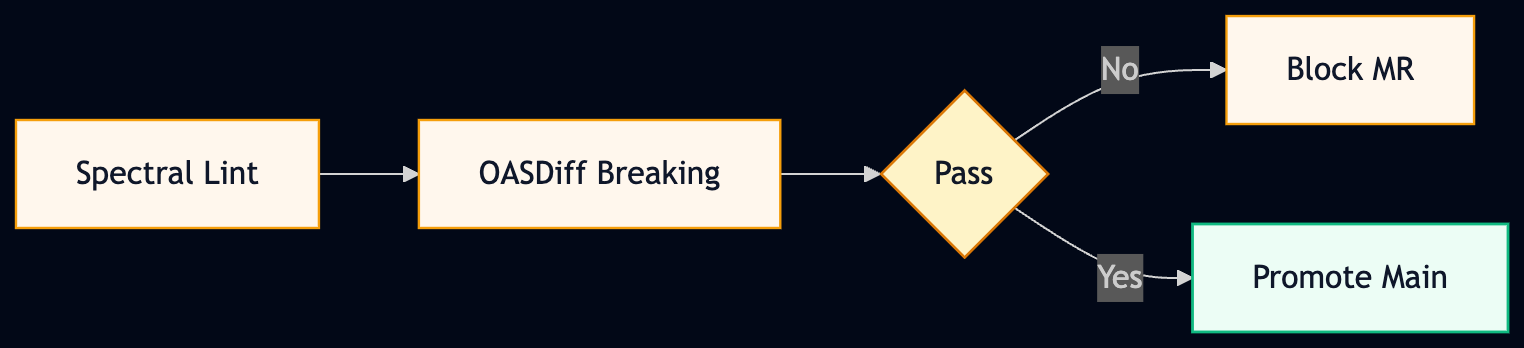
You can see the same pattern end-to-end on GitLab—blocked MR pipeline plus changelog-style feedback in the thread—in openapi-contracts merge request !6 (a deliberate demo branch; meant for CI validation, not to merge).
Stage 4 — Publish contract documentation
Once the contract is accepted, published docs are the stable face for humans who will not read YAML. Same version consumers trust; no “docs in a wiki that disagree with the repo.”

Stage 5 — Generate consumer client
From the same source of truth, clients or stubs reduce hand-written glue and keep call sites aligned with the contract. In many enterprises this stage stays transitional for a while—for example legacy paths that copy specs into resources—before fully converging on generation from the repo of record.

Stage 6 — Consumer adoption
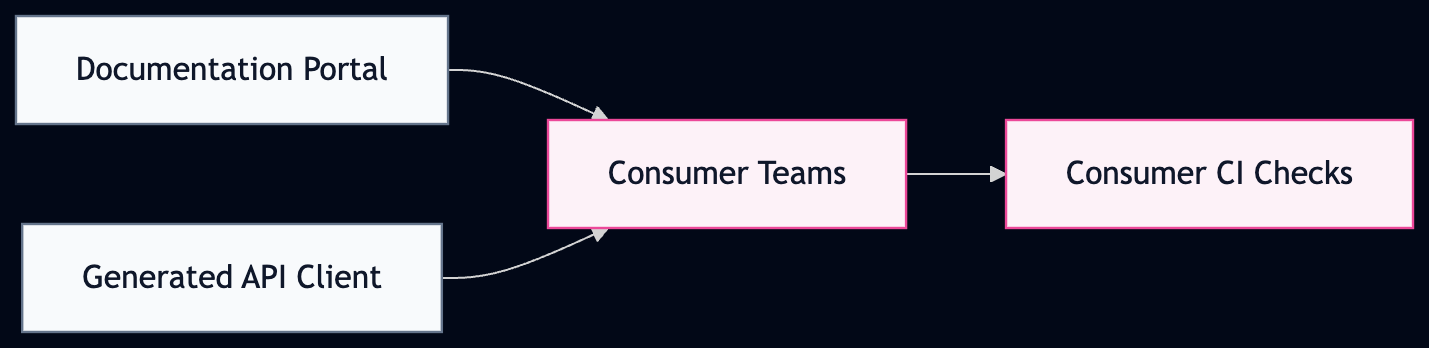
Consumer teams integrate against the published documentation from Stage 4. They build clients in the style that fits their stack—Feign, RestTemplate, or other internal patterns. They can trust what they read because every contract behind those docs has already passed Spectral validation, OASDiff compatibility checks, and architect review before publication. Governance guarantees contract correctness; implementation choice stays with each consumer team.
Stage 7 — Feedback loop
Production pain, exceptions, and audit findings feed back into governance: templates, rules, and baselines evolve. The flowline closes here; otherwise stage 0 is a static poster instead of a living system.

The design principle that cuts across all of them:
AI drafts. Humans decide. Gates enforce.
AI belongs inside the workflow by design. It is never treated as an uncontrolled source of truth: ownership, review, and automated compatibility checks still define what merges and what ships.
Evidence you can clone, not slides alone
The story above is backed by a public reference implementation you can inspect and run yourself: api-flowline on GitLab. There you will find the automation wiring—not a slide deck—showing how policy becomes CI behavior.
How the reference runs end to end
This diagram matches the same lifecycle as the eight stages above, laid out as horizontal zones: governance foundation, contract authoring, MR quality gates, automated delivery from main, then consumer adoption—with numbered flow cues (initiate → merge triggers delivery → published client consumed) so the eye follows the chain in one glance.
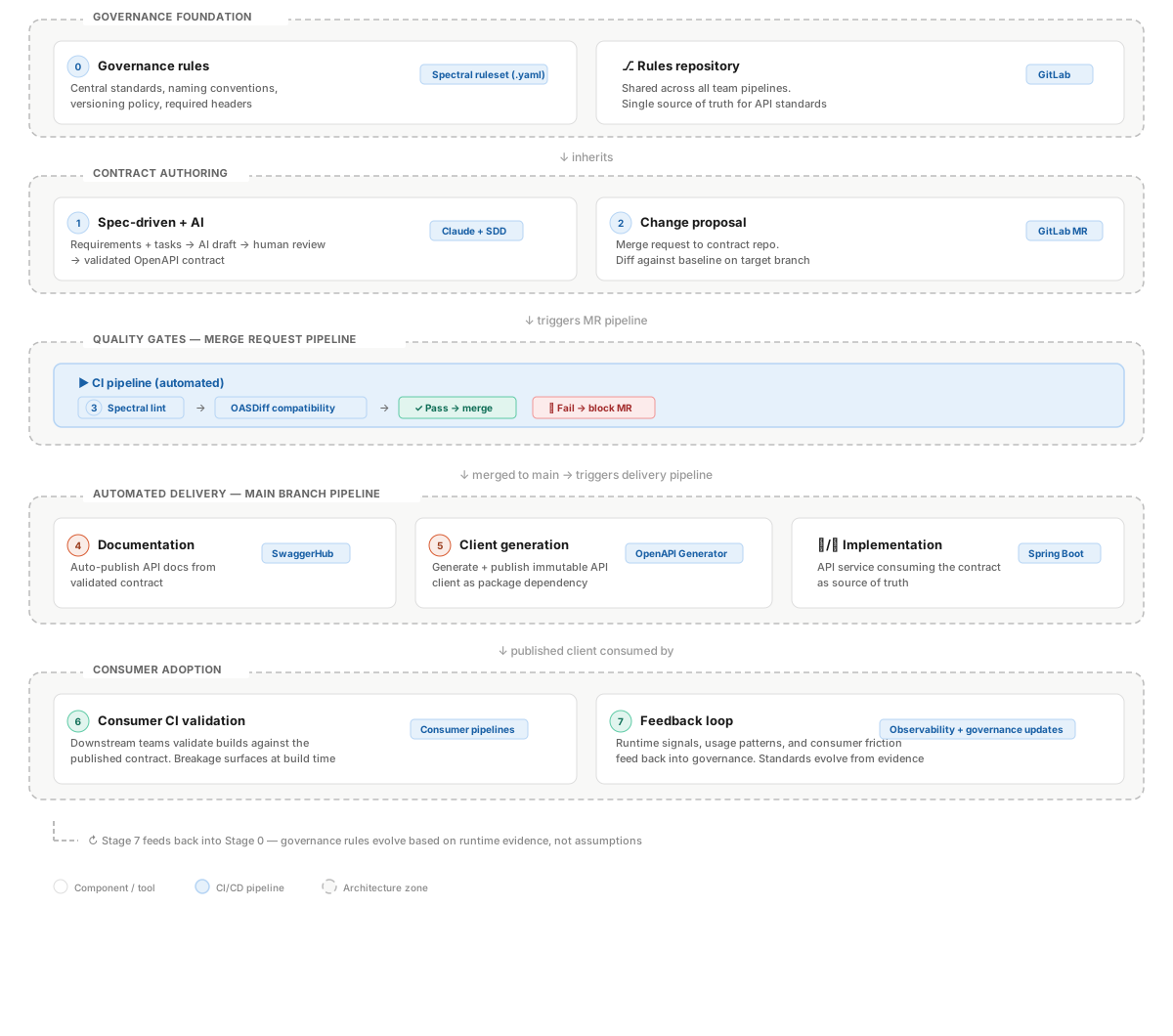
Stage 0 — Governance foundation. Spectral (asset-centric rules in YAML) encodes naming, versioning, headers, and org standards. A CI/CD rules repository on GitLab is the shared source of truth so every pipeline inherits the same policy.
Stages 1–2 — Contract authoring and change proposal. Requirements → tasks → AI-assisted draft (Claude + NEO) → human review → validated OpenAPI. The change lands as a GitLab merge request with a diff from the baseline on the target branch—so “what changed?” is always explicit.
Stage 3 — Quality gates on the MR pipeline. CI runs automatically on that MR: Spectral lint for standards; OASDiff for backward compatibility. Green → merge; red → MR blocked until the contract is fixed or the change is scoped (for example a deliberate major bump).
Stages 4–5 — Delivery from main. After merge, Redocly publishes documentation from the validated contract, and OpenAPI Generator builds and publishes an immutable client package. The Spring Boot service (or equivalent) implements against the same contract so runtime, docs, and generated clients stay aligned.
Stages 6–7 — Adoption and feedback. Consumer teams run consumer pipelines / CI against the published contract so schema drift surfaces at build time. Observability and runtime friction feed governance updates—the diagram’s loop is explicit: stage 7 feeds back into stage 1 (authoring and standards evolve from evidence, not assumptions).
Concretely, the repo demonstrates enforceable outcomes, not only artifacts:
- On a demo branch, a compatibility-breaking OpenAPI change is detected and blocked.
- On main, the normal pipeline stays green.
You should see CI failures that read like engineering, not like “please fix later.” A representative compatibility gate might emit something in this shape (tooling-specific wording will vary; the substance is the same):
❌ Breaking change detected — merge blocked

  GET /payments/{paymentId}
  - Parameter 'paymentId' type changed: string → integer

  Pipeline blocked. Bump major version (or narrow the change) to proceed.
That distinction matters. A governance model is not a diagram; it is what CI does when someone pushes the wrong diff. Fork the project, run the pipelines, and you get the same signals—not a narrative alone.
Trade-offs (and how we mitigate them)
Open tooling and federated execution are strong, not free:
- More internal operational ownership — you own the pipelines and templates, not a vendor SLA for “the platform.”
- Fragmentation risk if standards are not centralized where it counts.
- Cultural dependency — governance has to be adopted, not only written in Confluence.
- Hidden time cost even when license cost is low—someone maintains Spectral rules, baselines, and exceptions.
- Scale pressure as domains and teams multiply.
Our mitigations are explicit in the operating model:
- API governance squad + DevSecOps as a shared backbone.
- Standard templates and pipeline baselines so domains do not reinvent every gate.
- Central policy, federated execution—rules owned centrally; squads run the same kinds of checks in their repos.
- Exception paths and compliance-style metrics so “we could not ship” has a documented escape hatch, not silent waiver.
We do not pretend the risks are zero. We name them and manage them as org capability, not as a single hero repo.
Closing the loop
We are building a practical, enterprise-grade API governance path with open tooling, and AI integrated in a controlled way—not as a replacement for judgment, but as leverage on top of contracts and gates.
Early value is already visible: contract visibility, clearer ownership, and pipeline proof that compatibility controls work.
Next is to finish the middle and tail of the flowline—quality gates, documentation publication, and consumer adoption—so the eight stages read as one closed loop, not a partial diagram.
That split—human judgment plus gates, not unchecked generation—is what keeps “AI-accelerated” from meaning “AI-unaccountable.”
AI gives speed. Governance gives trust. Together, they give scale.